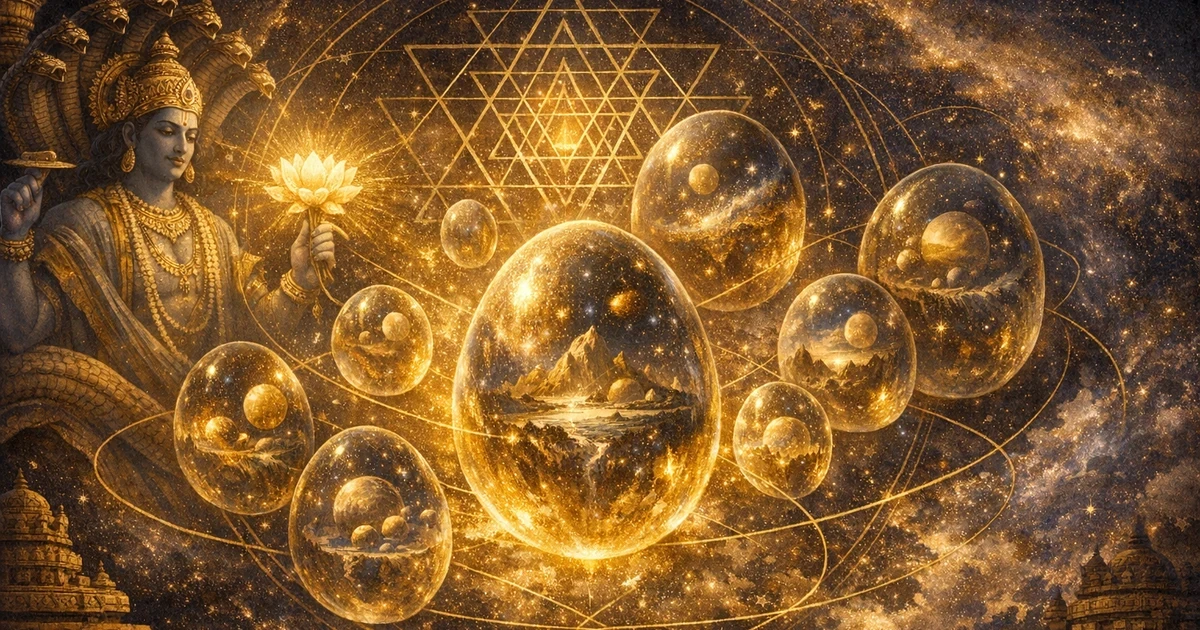
When Hugh Everett proposed the many-worlds interpretation of quantum mechanics in 1957, he described a universe that branches into countless parallel versions at every quantum event. The idea was considered radical, even outlandish, by his contemporaries. Yet the Bhagavata Purana, composed well over a thousand years earlier, presented a cosmological framework in which infinite universes exist simultaneously, each containing its own complete reality, each governed by its own Brahma, each unfolding on timescales so vast they dwarf anything in modern astrophysics.
This is not a case of retrofitting ancient texts to match modern science. The Puranic multiverse is articulated with specificity and internal consistency that rewards close examination. Whether one reads it as literal cosmology, philosophical metaphor, or inspired intuition, the parallels with contemporary physics are too detailed to dismiss.
Infinite Universes in the Bhagavata Purana
The Bhagavata Purana describes creation as an ongoing, infinite process. Maha Vishnu reclines on the cosmic serpent Ananta Shesha upon the causal ocean, and from each pore of his skin, a universe emerges like a bubble. These universes are not sequential. They exist simultaneously, each self-contained, each with its own laws, its own gods, its own cycles of creation and dissolution.
This imagery bears a structural resemblance to the eternal inflation model in modern cosmology, where our observable universe is one bubble in an endlessly inflating meta-space, with new bubble universes constantly forming. The Puranic description differs in its theological framing, attributing the generative process to divine will rather than quantum field dynamics, but the topological picture is strikingly similar: an infinite substrate giving rise to countless independent cosmoses.
Each universe, according to the Bhagavata Purana, is enclosed in a series of concentric shells composed of the fundamental elements, each shell ten times thicker than the one within it. This layered structure has been compared to the concept of nested dimensionality in string theory, where additional spatial dimensions are compactified at scales beyond direct observation.
The Fourteen Lokas: A Vertical Map of Reality
Within each universe, Hindu cosmology describes fourteen Lokas, or planes of existence, arranged vertically with seven ascending and seven descending. The upper Lokas begin with Bhuloka (the earthly plane) and rise through Bhuvarloka, Svargaloka, Maharloka, Janaloka, Tapoloka, and finally Satyaloka, the realm of Brahma. Below Bhuloka descend seven Patalas, subterranean realms inhabited by Nagas, Asuras, and other beings.
These are not understood as physical locations stacked in three-dimensional space. The tradition describes them as different frequencies or densities of existence, accessible not through physical travel but through shifts in consciousness, yogic attainment, or karmic elevation. This framework has drawn comparisons to the concept of parallel dimensions in theoretical physics, where different planes of reality might coexist in the same spatial coordinates but remain separated by dimensional barriers.
The inhabitants of different Lokas experience time at different rates, a detail that maps onto Vedic time cycles with mathematical precision. One year of human life corresponds to one day for the Devas in Svargaloka. This time dilation across planes resonates with relativistic physics, where the passage of time varies depending on gravitational fields and relative velocity.
Brahma's Lifespan: 311 Trillion Years of Cosmic Accounting
The timescales in Hindu cosmology are among the most extraordinary features of the system. Brahma, the creator god within a given universe, has a lifespan of 100 Brahma years. Each Brahma day, called a Kalpa, lasts 4.32 billion human years, roughly the current estimated age of Earth. Each Brahma night is equally long. During the day, creation unfolds. During the night, it dissolves back into latent potential, only to re-emerge the next morning.
A Kalpa is subdivided into 14 Manvantaras, each presided over by a Manu, a progenitor figure. Each Manvantara contains 71 Maha Yugas, and each Maha Yuga consists of four Yugas: Satya, Treta, Dvapara, and Kali, spanning 4,320,000 years collectively. The total lifespan of Brahma works out to approximately 311.04 trillion human years.
When Brahma dies, the universe he governs dissolves completely in a Maha Pralaya, a great dissolution. Then, from the body of Maha Vishnu, a new universe bubbles forth, a new Brahma is born, and the cycle begins again. There is no ultimate beginning and no final end, only an infinite series of cosmic inhalations and exhalations.
This cyclic cosmology stands in contrast to the linear Big Bang model of Western physics, but it finds surprising harmony with more recent proposals like the cyclic model of Steinhardt and Turok, which posits that Big Bangs may occur repeatedly as parallel branes collide in higher-dimensional space.
Many-Worlds Theory and the Puranic Framework
The many-worlds interpretation of quantum mechanics holds that every quantum measurement causes the universe to split into branches, one for each possible outcome. All branches are equally real. No information passes between them. The total number of parallel realities grows without limit.
The Puranic multiverse differs in mechanism but shares key structural features. Both frameworks assert the simultaneous existence of countless complete realities. Both deny a privileged or unique status to our own observable universe. Both operate on scales that are, in the most literal sense, incomprehensible to unaided human cognition.
There is also a shared philosophical consequence: in both systems, what we experience as reality is a vanishingly small slice of what exists. The Puranas make this explicit through the concept of Maya, the veil of illusion that causes beings to mistake their local experience for the totality of existence. Modern physics arrives at a similar conclusion through different reasoning: our observable universe, bounded by the cosmic microwave background, represents an infinitesimal fraction of the inflationary multiverse.
The Role of Consciousness
Where Hindu cosmology departs most decisively from Western frameworks is in the role it assigns to consciousness. In the Puranic model, consciousness is not an emergent property of matter. It is fundamental, preceding and pervading all material manifestation. The universes emerge from Vishnu's awareness. The Lokas are differentiated by the quality of consciousness that inhabits them. Liberation, Moksha, is achieved not by traveling to a different physical location but by awakening to the true nature of consciousness itself.
This primacy of consciousness has found unexpected resonance in certain interpretations of quantum mechanics, particularly the observer-dependent models that struggle with the measurement problem. While mainstream physics does not endorse a consciousness-first cosmology, the hard problem of consciousness remains unsolved, and the Puranic framework offers one of the oldest and most internally consistent models for how awareness might relate to physical reality.
Time, Cycles, and the Pulse of Existence
The Puranic universe breathes. Creation and dissolution alternate like inhalation and exhalation. Day follows night follows day, at every scale from the human to the cosmic. This pulsation is not a defect or a limitation. It is the fundamental rhythm of existence, the heartbeat of Brahman.
Modern cosmology has increasingly moved toward cyclic models as alternatives to the one-shot Big Bang, partly because a universe with a beginning but no end raises uncomfortable questions about boundary conditions and fine-tuning. The Puranic solution, an infinite chain of cycles with no absolute beginning or end, sidesteps these problems entirely. It is not that the ancient sages anticipated modern physics. It is that they confronted the same deep questions about origins, endings, and the nature of existence, and arrived at answers that remain philosophically viable millennia later.
The timekeeping systems of Jyotish, from the Yuga cycle down to the Tithi and Nakshatra divisions, are downstream applications of this cosmological framework. Every planetary position calculated in a birth chart exists within the context of Brahma's day, within one of fourteen Manvantaras, within one of seventy-one Maha Yugas. The chart is a snapshot of one moment in a cycle that has been running for billions of years and will continue for billions more.
Living Within the Multiverse
The practical implication of the Puranic multiverse is not that we should attempt to visit other universes or other Lokas. It is that we should recognize the vastness of the context in which our lives unfold. The birth chart, the Panchangam, the Dasha system, these are tools for navigating one human life within one cosmic cycle within one universe among infinite others. Their precision and their limitations both follow from this framing.
If the scale of Hindu cosmology inspires wonder or shifts your perspective on where you sit in the fabric of existence, explore your own place in this vast cycle. Generate your Kundli on Kaalis and see the cosmic coordinates of the moment you entered this particular universe, on this particular day of Brahma, in this particular turning of the wheel.
Discussion
No comments yet. Be the first to share your thoughts.